|
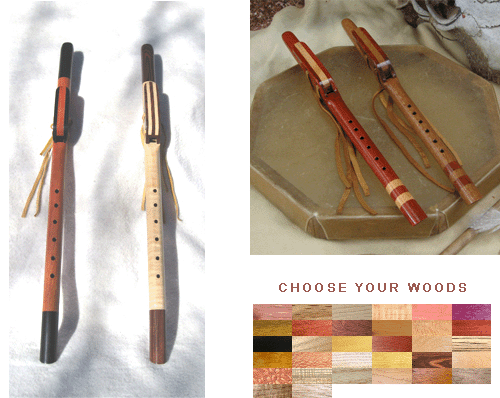
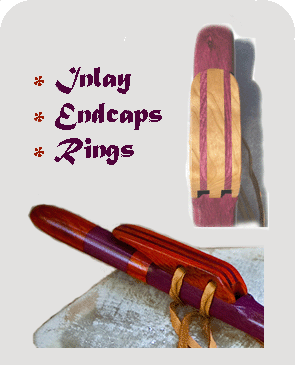
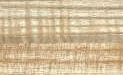
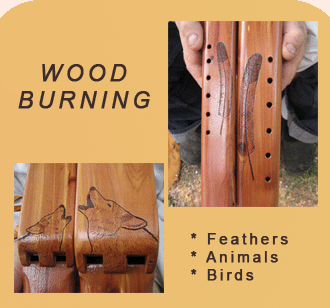
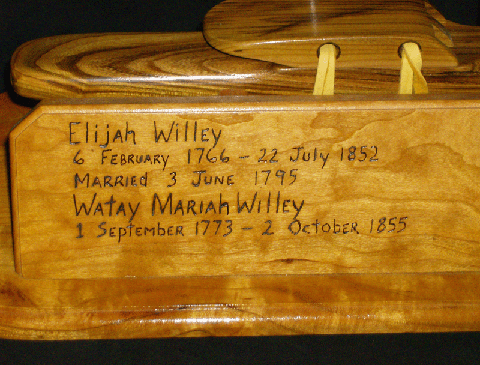
INLAY, ENDCAPS, RINGS, OR WOOD BURNINGS
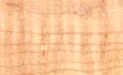
Choose one of our favorite combination flutes or combine any
woods that you like. Your flute can have inlay, endcaps, rings,
and wood burnings.
SEND US YOUR PIECE OF WOOD
If you have a piece of wood that is special to you, send it to
us and we will make you a flute from it. It generally takes 6-12
months to air dry a piece of fresh cut wood before we can work
it. Walnut Wood must be kiln dried.
COMPLEMENTARY FLUTES
Choose two flutes that are tuned to play in harmony with each
other.
SPECIAL TUNINGS AND PITCH ALTERNATIVES
Choose a flute that has a "special tuning". Our standard
tuning is A440. However, we can tune your flute to any tuning
that you prefer. Over the years, the most common requests for
alternate tunings have been: A430, A432, A444, A450. There is
a lot of information available for you to read regarding the
healing properties and history of these alternate tunings. Do
some research if you are considering an alternate tuning.
"The A used by most symphony and opera orchestras today
for uniform tuning ranges between 440 hertz, or cycles per second,
to 444 hertz. By comparison, in 1740, Handel favored an A pitched
at 422 hertz. Mozart, in 1780, tuned to an A at 421.6 hertz.
The French standardized their A at 435 hertz in 1858. A little
more than 20 years later, Verdi succeeded in getting a bill passed
by the Italian Parliament to tune at A 432 hertz.
In 1938, an international
standard for A was set at 440 hertz, but the pitch continued
to rise. The New York Philharmonic, under Zubin Mehta, tunes
to an A at 442 hertz, as does the Chicago under Georg Solti and
the Boston Symphony under Seiji Ozawa. In Berlin, orchestras
tune to an A around 448 hertz. In Moscow, the symphony's pitch
is even higher, near 450 hertz." ... www.nytimes.com
.. |
|























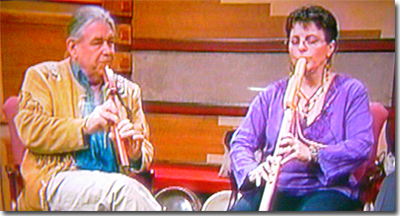
 Hear Duets








 All
Rights Reserved http://www.FretwellFlutes.com - Phone:(417) 535- 6032
All
Rights Reserved http://www.FretwellFlutes.com - Phone:(417) 535- 6032


